In Deciding What to Buy, the Consumer Will Choose the Good With the
Introducing the Budget Constraint
Upkeep constraints stand for the plausible combinations of products and services a heir-apparent tin can purchase with the available capital on hand.
Learning Objectives
Talk over the role of the budget set and indifference curve in determining the choice that gives a consumer maximum satisfaction
Key Takeaways
Primal Points
- Consumers analyze the optimal fashion in which to leverage their purchasing power to maximize their utility and minimize opportunity costs through employing trade -offs.
- The fashion economists demonstrate this arithmetically and visually is through generating budget curves and indifference curves.
- Budget curves indicate the relationship between two goods relative to opportunity costs, which defines the value of each good relative to one another.
- Indifference curves underline the way in which a given consumer interprets the value of each adept relative to 1 another, demonstrating how much of 'good [latex]x[/latex]' is equivalent in utility to a certain quantity of 'good [latex]y[/latex]' (and vice versa).
- Through utilizing these economic tools, economists can predict consumer behavior and consumers can maximize their overall utility based upon their upkeep constraints.
Key Terms
- Merchandise-offs: Any situation in which the quality or quantity of ane thing must be decreased for some other to be increased.
- utility: The ability of a commodity to satisfy needs or wants; the satisfaction experienced by the consumer of that article.
The concept of budget constraints in the field of economics revolves around the idea that a given consumer is limited in consumption relative to the corporeality of capital they possess. As a result, consumers analyze the optimal way in which to leverage their purchasing ability to maximize their utility and minimize opportunity costs. This is achieved through using upkeep constraints, which represent the plausible combinations of products and/or services a buyer is capable of purchasing with their capital on mitt.
Trade-offs
To aggrandize upon this definition further, the concern concept of opportunity cost via trade-offs is a central building cake in understanding budget constraints. An opportunity toll is divers as the foregone value of the next all-time culling in a given action. To employ this to a existent-life situation, pretend yous take $100 to spend on food for the month. Yous accept a wide diversity of options, just some will provide yous with higher opportunity costs than others. You could buy plenty breadstuff, rice, milk and eggs to feed yourself for the full month or y'all could buy premium cutting steak and store-prepared dinners by the pound (which would last about one week). The opportunity price of the sometime is the high quality foods which have the convenience cistron of already being prepared for y'all while the opportunity cost of the latter is having enough food to feed yourself for the entire month. In this circumstance the decision is easy, and the trade off volition be sacrificing convenience and high quality food for the power to accept enough food on the tabular array over the course of the whole calendar month.
Budget Curves and Indifference Curves
Understanding these trade-offs underlines the true function of budget constraints in economic science, which is identifying which consumer behaviors will maximize utility. Consumers are inherently equipped with an infinite demand and a finite pool of resource, and therefore must make budgetary decisions based on their preferences. The way economists demonstrate this arithmetically and visually is through generating upkeep curves and indifference curves.
Upkeep curves: This indicates the relationship between two goods relative to opportunity costs, which defines the value of each skillful relative to one another. For case, on the figure provided a quantity of 5 for 'skilful [latex]y[/latex]' is identical in cost (economic value) as a quantity of 7 for 'good [latex]x[/latex]'. This demonstrates the trade-off ratio betwixt the two available products or services. It is of import to keep in mind that prices and valuations of goods are constantly irresolute, and that the ratio between whatsoever ii goods is non fixed over the long-term for most products/services.

Budget Curve: A budget curve demonstrates the human relationship betwixt two goods relative to opportunity costs, essentially deriving the relative value of each practiced based on quantity and utility. Proceed in heed that moving from one signal on the in to another is trading off '[latex]x[/latex]' amount of one good for '[latex]y[/latex]' corporeality of some other.
Indifference curves: Indifference curves underline the way in which a given consumer interprets the value of each proficient relative to one another, demonstrating how much of 'adept [latex]x[/latex]' is equivalent in utility to a sure quantity of 'proficient [latex]y[/latex]' (and vice versa). Any point along the indifference curve will correspond indifference to the consumer, or simply put equivalent preference for i combination of goods or the other. In the figure information technology is clear that the budget bend has been included in conjunction with the indifference curves, which allows insight equally to the ideal actual quantity of each good is optimal for this specific consumer.

Indifference Curves: Indifference curves are designed to correspond an equal perception of overall value in a given handbasket of goods relative to a specific consumer. That is to say that each point forth the curve is considered by the consumer of equivalent value despite alterations in the quantity of each good, equally these merchandise-offs are consider of equal value and thus indifferent.
Through utilizing these economic tools, economists tin can predict consumer behavior and consumers can maximize their overall utility based upon their budget constraints.
Mapping Preferences with Indifference Curves
Economists mapping consumer preferences use indifference curves to illustrate a series of goods that represent equivalent utility.
Learning Objectives
Describe the indifference curves for goods that are perfect substitutes and complements
Key Takeaways
Key Points
- Indifference curves illustrate bundles of appurtenances that provide the same utility.
- An economist tin can derive conclusions based upon the backdrop of the analogy. In framing these implications it is useful to identify the 2 potential extremes of substitute appurtenances and complementary goods.
- The comparison between the goods demonstrates the relative utility one has compared to another, and the fashion in which consumers will act when posed with a decision between various products and services.
- The comparing between the goods demonstrates the relative utility ane has compared to some other, and the way in which consumers will act when posed with a conclusion between various products and services.
Key Terms
- substitute: A good with a positive cross elasticity of need, significant the good's demand is increased when the toll of another is increased.
- Complement: A good with a negative cross elasticity of demand, pregnant the good'southward demand is increased when the price of another good is decreased.
A disquisitional input to understanding consumer purchasing behaviors and the general demand present in a given market place or economy for specific appurtenances and services is the identification of consumer preferences. Consumer preference varies substantially from private to individual and marketplace to market, requiring comprehensive economic observation of consumer choices and behaviors. One of the main tools leveraged by economists mapping consumer preferences is the indifference curve, which illustrates a series of bundled appurtenances in which a consumer is indifferent. A consumer would be just equally happy with whatever combination of Skillful 10 and Good Y on the curve. This could synonymous to saying baskets of goods that provide the same utility.
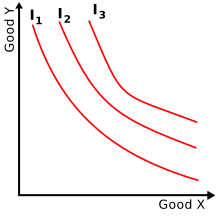
Indifference Curve: A consumer will be just equally happy with whatsoever combination of Proficient X and Y on indifference bend I1, though s/he will prefer whatever bundle on indifference bend I2 or I3.
These indifference curves, when mapped graphically alongside other curves, is called an indifference map. A primal consideration in creating whatsoever indifference map is what relative preferences should be isolated. While it is possible to create a complex array of preference maps to compare more than 2 products/services, each specific standard indifference map will exist nigh creating a benchmark betwixt two. For instance one could compare relatively like goods/services (i.eastward. apples vs. oranges) or dramatically different goods/services (i.e. university preparation vs. motorcar purchasing). These two items being compared represent the x and y axis of a indifference map. A consumer will always adopt to exist on the indifference curve uttermost from the origin.
Implications of Indifference Maps
Subsequently amalgam the required inputs to generate a comprehensive indifference map, an economist can derive conclusions based upon the properties of the illustration. In framing these implications it is useful to place the two potential extremes that can be outlined via with indifference curves:
- Perfect Substitutes: To understand what a indifference curves volition look like when products are perfect substitutes, please come across the graph below. These lines are essentially perfectly straight, and that demonstrates that the relative utility of 'Good X' compared to that of 'Good Y' is equivalent regardless of the amount in question. It is reasonable to assume in this scenario that purchasing all of 1 or all of the other will not decrease the overall satisfaction of the consumer. Perfect substitutes are often homogeneous goods. A consumer with no preference between Burger Rex and McDonald's, for example, might consider them perfect substitutes and exist indifferent to spending all of their fast nutrient money on ane or the other.
- Perfect Complements: The opposite of a perfect substitute is a perfect complement, which is illustrated graphically through curves with perfect right angles at the center. These right angles, and the subsequent straight horizontal and vertical lines, demonstrate that 'Good Ten' and 'Skillful Y' are inherently tied to 1 another and that the consumption of ane is dependent upon the consumption of the other. An example of complementary appurtenances might exist university tuition and bookish textbook purchases, an automobile and automobile insurance, or a cable and a television.
Combining an understanding of these inputs with the extremes demonstrated an indifference map, economists are able to draw meaningful conclusions regarding consumer choices and purchasing behaviors in the context of two goods. The comparison between the goods demonstrates the relative utility one has compared to some other, and the way in which consumers will act when posed with a decision between various products and services.

Perfect Substitute Indifference Bend: In this particular series of indifference curves it is articulate that 'Expert X' and 'Adept Y' are perfect substitutes for ane another. That is to say that the utility of i is identical to the utility of the other across all quantities represented on the map.

Perfect Complement Indifference Curve: The perfect right angle in this series of indifference curves implies that the utility of 'Skillful X' and 'Good Y' are entirely interdependent. This is to say that in order to enjoy one skillful information technology is necessary to also have the other.
Backdrop of Indifference Curves
Near all indifference curves will be negatively sloped, convex, and will not intersect.
Learning Objectives
Analyze the backdrop that are common to many indifference curves
Key Takeaways
Key Points
- The concept of an indifference bend is predicated on the idea that a given consumer has rational preferences in regard to the purchase of groupings of goods, with a serial of key properties that define the process of mapping these curves.
- Indifference curves but reside in the non-negative quadrant of a two-dimensional graphical illustration (or the upper right).
- Indifference curves are e'er negatively sloped. Essentially this assumes that the marginal rate of exchange is ever positive.
- All curves projected on the indifference map must not intersect in gild to ensure transitivity.
- Well-nigh all indifference lines will exist convex, or curving inwards at the center (towards the bottom left).
Fundamental Terms
- utility: The ability of a commodity to satisfy needs or wants; the satisfaction experienced by the consumer of that article.
- Transitive: Having the property that if an element x is related to y and y is related to z, then x is necessarily related to z.
Indifference curves trace the combination of goods that would give a consumer a certain level of utility. The indifference bend itself represents a serial of combinations of quantities of appurtenances (generally two) that a consumer would be indifferent between, or would value each of them as in regards to overall utility. Indifference curves allow economists to predict consumer purchasing behaviors based upon utility maximization for a bundle of appurtenances inside the context of a given consumer'due south budget constraints and preferences.
Properties of Indifference Curves
The concept of an indifference bend is predicated on the idea that a given consumer has rational preferences in regard to the buy of groupings of appurtenances, with a series of key properties that define the process of mapping these curves:
- Indifference curves but reside in the non-negative quadrant of a two-dimensional graphical illustration (or the upper right). This assumes that negative quantities are meaningless – ane tin't eat a negative amount of a proficient.
- Indifference curves are ever negatively sloped. This is based on the supposition that a consumer is always better off consuming more of a good, so as quantity consumed of one good increases, full satisfaction would increase if not offset by a decrease in the quantity consumed of another proficient. This also assumes that the marginal rate of substitution is ever positive.
- All curves projected on the indifference map must also exist transitive to ensure that if [latex]A[/latex] is preferred to [latex]B[/latex] and [latex]B[/latex] is preferred to [latex]C[/latex], [latex]C[/latex] is not likewise preferred to [latex]A[/latex]. This is manifested in indifference curves that never intersect.
- Nearly all indifference lines volition be convex, or curving in at the heart (towards the bottom left). This demonstrates that increasingly high quantities of one skilful over another have a cost in respect to their overall utility per unit of measurement (diminishing returns). It is technically possible for indifference curves to exist perfectly directly as well, which would imply that the ii goods are identical (perfect substitutes).
Combining these various backdrop, one can highlight a number of critical implications of consumer purchasing behavior and the concept of utility. Consumers naturally want a bundle of appurtenances that is varied (hence the convex curves for nigh comparisons) in order to maximize their utility. Similarly, all indifference curves volition naturally place diminishing rates of substitution equally the quantity increases for a certain skillful compared to another, and can create demand projections of prospective supply.
Impact of Income on Consumer Choices
One of the central considerations for a consumer'due south consumption choice is income or wage levels, and thus their budgetary constraints.
Learning Objectives
Break down changes in consumption into the income upshot and the wealth result
Fundamental Takeaways
Key Points
- The basic premise behind the income result is that varying income levels volition determine different quantities and balanced baskets along the provided indifference curves for whatsoever ii goods being compared.
- These differences in quantity reverberate the increase or decrease an a given private's purchasing power, thus the income result could be summarized as the increase in relative utility captured by a consumer with more than monetary power.
- Income furnishings on consumer pick grow more than complex as the type of skilful changes, as different product and services demonstrate unlike properties relative to both other products/services and a consumers preferences and utility.
- The four central types of goods to consider are normal goods, junior appurtenances, complements and substitutes.
Key Terms
- Inferior appurtenances: A good that decreases in demand when consumer income rises; having a negative income elasticity of need.
- Income Effect: The alter in consumption choices due to changes in the corporeality of money available for an individual to spend.
- Wealth Effect: The change in an private's consumption choices due to changes in perception of how rich south/he is.
Consumer choices are predicated on diverse economic circumstances, and recognizing the relationship between these circumstances and an individual's purchasing behavior allows economists to recognize and predict consumer choice trends. Ane of the central considerations for a consumer in deciding upon their purchasing behaviors is their overall income or wage levels, and thus their monetary constraints. These budgetary constraints, when practical to a series of products and services, can be optimized to capture the nearly utility for the consumer based on their purchasing power.
Income from a Consumer Theory Perspective
The simplest way to demonstrate the effects of income on overall consumer choice, from the viewpoint of Consumer Theory, is via an income-consumption curve for a normal skilful. The basic premise behind this curve is that the varying income levels (every bit illustrated by the light-green income line curving upwards) will decide dissimilar quantities and balanced baskets along the provided indifference curves for the two goods being compared in this graph. These differences in quantity reverberate the increase or decrease an a given private'south purchasing power, thus the income effect could be summarized as the increase in relative utility captured by a consumer with more monetary power.

Income-Consumption Curve: Simply put, increases or decreases in income will modify the optimal quantity (and thus relative utility) of a given basket of appurtenances for a specific consumer.
The wealth outcome differs slightly from the income issue. The wealth result reflects changes in consumer choice based on perceived wealth, non actual income. For example, if a person owns a stock that appreciates in price, they perceive that they are wealthier and may spend more, even though they take non realized those gains and so their income has not increased.
Effects of Income on Different Goods
Income effects on consumer option grow more complex as the blazon of adept changes, as different product and services demonstrate different properties relative to both other products/services and a consumers preferences and utility. Equally a result, it is useful to outline the differences in income furnishings on normal, inferior, complementary and substitute goods:
- Normal: A normal good is a good with incremental increases or decreases in utility as quantity changes, demonstrating a predictable and simple linear relationship as income increases or decreases. demonstrates a graphical representation of the furnishings of income changes upon preference map.
- Junior: Inferior goods, or goods that are less preferable, volition demonstrate inverse relationships with income compared to normal goods. That is to say that an increment in income will not necessarily result in an increase in quantity for the junior expert, every bit the consumer derives minimal utility in purchasing the inferior adept compared to other goods. Inferior appurtenances are frequently sacrificed as income rises and consumers gain more choice/options. This can be represented in.
- Complementary: Complementary goods are goods that are interdependent in consumption, or substantially goods that crave simultaneous consumption by the consumer. An case of this would be like purchasing an automobile and machine insurance, the consumption of one requires the consumption of the other. As income increases, these will increase relative to one some other (as a ratio). demonstrates this concept in graphical form.
- Substitutes: Perfect substitutes are substantially interchangeable goods, where the consumption of one compared to another has no meaningful impact on the consumer's utility derived. Substitutes are goods that a consumer cannot differentiate between in terms of the need being filled and the satisfaction obtained. Income increases volition thus affect the consumption of these goods interchangeably, resulting in increase in the quantity of either or both.
In merging Consumer Theory and consumer choices with income level, the chief takeaway is that an increase in income will increment the prospective utility that consumer can acquire in the market. Understanding how this applies in a general style, alongside the specific circumstances dictating specific types of appurtenances, it becomes fairly straight-forward to predict consumer purchasing behaviors at differing income levels.

Income Levels and Inferior Goods: This graph demonstrates the changed relationship betwixt income and the consumption of inferior goods. As income rises, the quantity consumed of 'X1' decreases. This illustrates increased variance in consumer choice as income rises.

Income Result on Complementary Appurtenances: In this graphical delineation of income increases, the consumption of these two goods are complementary and thus interdependent.
Impact of Price on Consumer Choices
The demand bend shows how consumer choices respond to changes in price.
Learning Objectives
Construct the need bend using changes in consumption due to toll changes
Cardinal Takeaways
Key Points
- For normal appurtenances or services, demand is illustrated with a downward sloping bend, where the quantity on the x-axis will generally increase as the cost on the y-axis decreases (and vice versa).
- Equally the demand curve implies, toll is the primal driving forcefulness behind a determination to purchase a given production or service.
- A critical consideration of product/service pricing is the price elasticity of a given good, which indicates how responsive demand is to a modify in cost.
- Using demand curves, economists tin project the impact of a cost modify on the consumer choices in a given market place.
- The quantity demanded may alter in response to both to shifts in demand (and the creation of a new demand curve, every bit demonstrated in and movements along the established need curve.
Key Terms
- elasticity: The sensitivity of changes in a quantity with respect to changes in another quantity.
In almost all cases, consumer choices are driven past prices. Equally toll goes up, the quantity that consumers demand goes downwardly. This correlation betwixt the price of goods and the willingness to make purchases is represented clearly by the generation of a demand curve (with price as the y-axis and quantity as the x-axis). The construction of need, which shows exactly how much of a good consumers will purchase at a given cost, is defining of consumer choice theory.
Deriving Overall Demand
The generation of a need curve is done by calculating what price consumers are willing to pay for a given quantity of a good or service. For normal goods or services, demand is illustrated with a downward sloping curve, where the quantity on the x-centrality will generally increase equally the price on the y-axis decreases (and vice versa). The quantity demanded may change in response to both to shifts in need (and the creation of a new need curve, as demonstrated in ) and movements along the established demand curve. A demand shift usually takes place when an external cistron increases or decreases demand beyond the board, while a movement upwards or downwards on the curve is indicative of a change in the practiced'due south price.
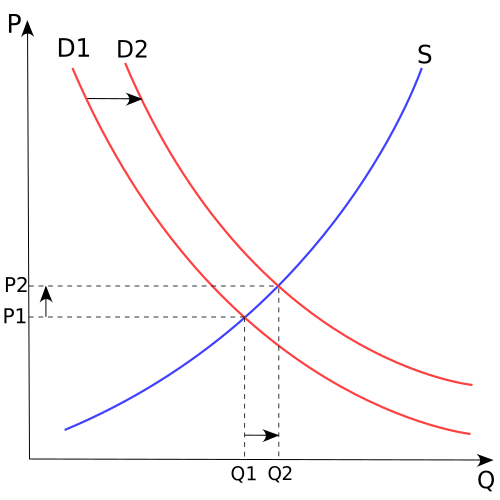
Demand Shifts: This graph demonstrates a shift in overall demand in the market, where the generation of a new parallel demand bend is required to accurately represent consumer choices.
Equally the demand curve implies, price is often the fundamental driving force backside a conclusion to buy a given production or service. Consumers must weigh the overall utility they tin capture by making a purchase and benchmark that against their overall monetary resources to optimize their purchasing decisions. This exercise regulates the price companies can set for their products and services, as the income effects and the prospective substitutions (substitution effect) volition drive consumer purchase towards purchases that create the almost value for themselves.
Price Elasticity
A critical consideration of product/service pricing is the price elasticity of a given good, which indicates how responsive demand is to a change in price. Price elasticity is essentially a measurement of how much any deviations in price volition bulldoze the overall quantity purchased up or down, underlining to what extent consumer purchasing decisions will be dictated by pricing. The figure pertaining to cost elasticity shows how the slope of the demand curve volition alter depending on the degree of price sensitivity in the marketplace for a expert. A highly elastic good will run across consumers much less likely to buy when prices are high and much more likely to buy when prices are low, while a good with depression elasticity will run across consumers purchasing the same quantity regardless of modest price changes.

Price Elasticity: As this graph demonstrates, the slope of the demand bend will vary as a directly result of how elastic consumer purchasing behaviors volition be compared to price changes.
Using demand curves, economists tin project the impact of a cost change on the consumer choices in a given market.
Deriving the Need Bend
The police of demand pursues the derivation of a demand curve for a given product that benchmarks the relative prices and quantities desired.
Learning Objectives
Explain how Giffen goods violate the police of demand
Primal Takeaways
Fundamental Points
- The derivation of demand is a useful tool in this pursuit, frequently combined with a supply curve in society to determine equilibrium prices and empathize the relationship between consumer needs and what is readily bachelor in the market.
- The inherent human relationship between the cost of a expert and the relative amount of that good consumers will demand is the fulcrum of recognizing demand curves in the broader context of consumer choice and purchasing behavior.
- More often than not speaking, normal goods will demonstrate a higher need as a consequence of lower prices and vice versa.
- Giffen goods are a situation where the income effect supersedes the substitution result, creating an increase in demand despite a ascent in cost.
- Neutral goods, unlike Giffen goods, demonstrate consummate ambivalence to price. That is to say that consumer swill pay any toll to get a fixed quantity.
Key Terms
- Giffen good: A practiced which people consume more of as simply the price rises; Having a positive cost elasticity of demand.
- Derivation: The operation of deducing one function from some other according to some fixed law, called the law of derivation, equally the of differentiation or of integration.
The law of demand in economics pertains to the derivation and recognition of a consumer's relative desire for a product or service coupled with a willingness and power to pay for or purchase that good. Consumer purchasing behavior is a complicated process weighing varying products/services confronting a constantly evolving economic backdrop. The derivation of demand is a useful tool in this pursuit, often combined with a supply bend in social club to determine equilibrium prices and understand the human relationship between consumer needs and what is readily available in the market.
Deriving Need Curves
Despite a broad array of prospective goods and services in a constantly altering economic surround, the law of demand pursues the derivation of a demand bend for a given product that benchmarks the relative prices and quantities desired by consumers in a given market place. The inherent human relationship between the price of a good and the relative amount of that good consumers will demand is the fulcrum of recognizing demand curves in the broader context of consumer choice and purchasing beliefs.
Generally speaking, normal goods will demonstrate a higher need as a event of lower prices and vice versa. The derivation of need curves for normal goods is therefore relatively anticipated in respect to the direction of the slope on a graph. The downwardly slope represented in this figure underline the critical principle that a given price point will reflect a given quantity demanded by a given marketplace, assuasive suppliers and economists to measure out the value of a product/service based on a price/quantity analysis of consumer purchasing behaviors.

Deriving the Demand Curve (Normal Goods): This illustration demonstrates the manner in which economists can identify a series of prices and quantities for goods demanded, which ultimately represents the overall need curve for a given product/service.
One important consideration in need curve derivation is the differentiation between demand curve shifts and move along the curve itself. Motion along the curve itself is the identification of what quantity will be purchased at different toll points. This means that the factors that underlie consumer desire for the product remains constant and consistent, but the quantity or price alters to a new bespeak forth the established bend. Alternatively, sometimes external factors can shift the actual demand for a given good, pushing the demand curve outwards to the right and upwardly or inwards downwardly and left. This represents a substantial change in the actual demand for that product, as opposed to a quantity or toll shift at a fixed need level.
Exceptions: Giffen Goods and Neutral Goods
With the concept of full general demand curves in heed, information technology is important to recognize that some goods do non adjust to the traditional assumption that higher prices will always demonstrate lower need. Giffen goods and neutral goods break this rule, with the former demonstrating an increase in demand as a result of a price rising and the latter demonstrating indifference to price in regards to the quantity demanded (illustrated as a completely vertical demand curve):

Demand Bend for Giffen Goods: Giffen goods are essentially appurtenances that demonstrate an increase in demand equally a result of an increase in price, mostly considered counter-intuitive in traditional economic models. This graph illustrates the derivation of a demand curve for these goods.
- Giffen Goods – Giffen goods are a state of affairs where the income effect supersedes the substitution effect, creating an increase in demand despite a rise in cost. Goods such as loftier-cease luxury items like expensive fashion often demonstrate this type of counter-intuitive tendency, where the high cost of an item is attractive to the consumer for the sake of displaying wealth.
- Neutral Goods – Neutral goods, different Giffen appurtenances, demonstrate complete ambivalence to price. That is to say that consumers will pay any price to get a fixed quantity. These goods are often necessities, defying the standard law of demand due to the fact that they must be purchased regardless of price/situation. A good example of this is water or healthcare, where non getting what is required will have dramatic consequences.
Applications of Principles on Consumer Choices
The income effect and substitution consequence combine to create a labor supply bend to represent the consumer trade-off of leisure and work.
Learning Objectives
Explain the labor-leisure tradeoff in terms of income and substitution effects
Key Takeaways
Key Points
- Economics assumes a population of rational consumers, subjected to the complexities of modern economics while they effort to maximize the utility obtainable within their income range.
- The income effect says that a consumers overall income level will have an event on the quantities of goods that consumer volition buy.
- The substitution effect, similar to the income issue, identifies ways in which consumer purchasing power will alter the relative quantities of goods/services purchased by consumers at varying income levels and budgetary constraints.
- Combining the commutation effect and the income consequence, one can derive an overall labor -leisure trade-off based on a given consumers purchasing ability (income) relative to the price of necessary bundles of appurtenances (substitution result).
- A rational consumer volition begin to work less hours later on coming together their consumption requirements in order to capture the value of leisure (and enjoy their income in a meaningful way).
Key Terms
- exchange effect: The alter in demand for i good that is due to the relative prices and availability of substitute goods.
- purchasing power: The amount of appurtenances and services that can be bought with a unit of currency or past consumers.
- Income Upshot: The change in consumption resulting from a modify in real income.
Economics assumes a population of rational consumers, subjected to the complexities of modernistic economics while they attempt to maximize the utility obtainable inside their income range. Central principles to analyzing consumer deportment and choices are income effect and the substitution issue, which ultimately generate a labor supply to illustrate the labor-leisure trade-off for consumers.
Income Outcome
The income effect needs 2 simple inputs: the average toll of appurtenances and the consumer's income level. This creates a relative buying power, which volition play a substantial role in the quantity of goods purchased. Predicting consumer pick requires inputs on consumer purchasing power and the goods in which they are deciding between. In nosotros are comparison 'Practiced Ten' and 'Expert Y' to identify how a change in income will alter the overall corporeality of each skillful would likely be purchased along a series of indifference curves. This graphical representation of a consumer's income (I) and budget constraints (BC) underlines the variance in quantity of 'Good Ten' and 'Good Y' that will be demanded dependent upon income circumstance. Naturally, a higher income will result in a shift towards increase in quantity for many consumable appurtenances/services.

Income Effects on Consumption and Budget Constraints: This graphical representation of a consumers income(I) and upkeep constraints (BC) underlines the variance in quantity of 'Skilful X' and 'Good Y' that will be demanded dependent upon income circumstance. Naturally, a college income will outcome in a shift towards increase in quantity for many consumable goods/services.
Substitution Effect
The substitution effect is closely related to that of the income effect, where the price of goods and a consumers income will play a role in the determination-making process. In the substitution event, a lower purchasing power volition generally result in a shift towards more affordable goods (substituting cheaper in place of more expensive goods) while a higher purchasing power often results in substituting more expensive goods for cheaper ones. This shows the relationship between two graphs, pointing out how the substitution effect identifies the relationship between the cost of a given practiced and the quantity purchased by a given consumer. As the bottom half of the effigy implies, a college price will dictate a lower quantity consumer for 'Proficient Y', while a lower price will create a college quantity. This translates to the graph above as the consumer makes choices to maximize utility when comparison the price of dissimilar goods to a given income level, substituting cheaper goods and more expensive goods dependent upon purchasing power.

Substitution Effect: This ii-part graphical representation of the substitution effect identifies the relationship betwixt the toll of a given good and the quantity purchased by a given consumer. As the bottom half effectively highlights, a higher price volition dictate a lower quantity consumer for 'Skilful Y', while a lower toll will create a higher quantity. This translates to the graph above equally the consumer makes choices to maximize utility when comparing the toll of different goods to a given income level.
Types of Appurtenances
One boosted of import component of consumer choice is the way in which different appurtenances demonstrate dissimilar reactions to income alterations and price changes:
- Income Changes: When income changes rises or falls, consumption of sure types of goods will have a positive or negative correlation with these changes. With normal goods, an increase of income will correlate with a higher quantity of consumption while a decrease in income will run into a decrease in consumption. Inferior goods, on the other hand, will demonstrate an inverse relationship. A ascension in income volition cause a decrease in their consumption and vice versa.
- Cost Changes: When price rises or falls, consumption of certain types of skillful will either demonstrate positive or negative correlations to these shifts in regard to quantity consumed. Ordinary goods will demonstrate the intuitive situation, where a rise in toll will event in a decrease in quantity consumer. Inversely, Miffen goods demonstrate a positive relationship, where the price rises volition effect in higher demand for the good and high consumption.
Labor Supply Curve
These concepts of income versus required budgetary inputs (prices) for appurtenances/services generates a relationship betwixt how much an individual volition choose to piece of work and how much an individual can take in terms of leisure time. Just put, desired labor and leisure time are dependent upon income and prices for appurtenances. The relationship between the number of hours worked and the overall wage levels results in something of a boomerang effect, with hours worked every bit the x-centrality and wages as the y-centrality.
Graphically represented, the labor supply curve looks like a backwards-bending bend, where an increase in wages from W1 to W2 will consequence in more than hours being worked and an increase from W2 to W3 will result in less. This is primarily due to the fact that there is a certain amount of capital attained by consumers where they will exist satisfied with their budgetary utility, at which indicate working more has diminishing returns on their satisfaction. A rational consumer volition begin to work less hours after coming together their consumption requirements in order to capture the value of leisure (and bask their income in a meaningful way).

Labor Supply Curve: The concept of labor supply economic science is most efficiently communicated via the post-obit graphical representation. This graph demonstrates the relationship between hours piece of work and overall wage rates, demonstrating the shift in utility as wages increase.
To apply this to the concept of different types of goods above, one tin view wage rates and leisure fourth dimension equally consumer goods. Depending on which signal on the backwards-bending curve we are on, the trade-offs and thus the consumer determination will change. If a worker choose to work more when the wage rate rises, leisure is an ordinary good.
Source: https://courses.lumenlearning.com/boundless-economics/chapter/theory-of-consumer-choice/
0 Response to "In Deciding What to Buy, the Consumer Will Choose the Good With the"
Post a Comment